Technologies
Express.js

Express.js is a minimal, unopinionated web application framework for Node.js — the server-side JavaScript runtime. It provides a thin layer of fundamental web application features on top of Node.js's built-in HTTP module, giving developers the tools to handle routing, middleware, and HTTP requests without imposing a rigid project structure or architectural pattern. Because it makes few assumptions about how an application should be organized, Express is often described as a micro-framework: it ships with just enough to get a server running, leaving the rest to the developer's discretion.
In practice, Express is most commonly used to build RESTful APIs and server-rendered web applications. It acts as the bridge between incoming HTTP requests and the application logic that processes them — matching URLs to handler functions, parsing request bodies, and sending responses. Its lightweight design makes it a popular foundation for larger architectures, including microservices and full-stack JavaScript applications where the backend is paired with a frontend framework.
Express.js was created by TJ Holowaychuk and first released in 2010, shortly after Node.js itself appeared. Holowaychuk drew inspiration from Ruby's Sinatra framework, aiming to give Node.js developers a minimal, unopinionated foundation for building web servers rather than a heavyweight, convention-driven system. The framework was donated to the Node.js Foundation (later merged into the OpenJS Foundation) in 2014, which helped cement its long-term governance and stability.
Within a few years of its release, Express had become the de facto standard web framework for Node.js, consistently ranking as one of the most downloaded packages in the npm registry. Its adoption was driven by a straightforward API, a large ecosystem of compatible middleware, and the absence of strong alternatives at the time. Even as newer frameworks emerged, Express retained its dominant position largely because of its maturity, broad community support, and the vast number of existing tutorials and third-party integrations built around it.
At its core, Express.js wraps Node.js's built-in http module, providing a thin but structured layer on top of Node's raw request and response objects. When an HTTP request arrives, Express passes it through a middleware pipeline—an ordered sequence of functions, each receiving the request object (req), the response object (res), and a next callback. Each middleware function can read or modify the request and response, execute logic such as authentication or body parsing, and then either send a response or call next() to pass control to the following middleware in the chain.
Express's routing system sits on top of this pipeline and maps incoming HTTP methods and URL patterns to specific handler functions. A route definition pairs a method—such as GET or POST—with a URL path and one or more handler functions that behave like middleware. Routes can be defined directly on the application object or grouped using Router instances, which allow related routes to be organised into modular units and mounted at a given path prefix. This design keeps application code structured and makes it straightforward to isolate concerns such as authentication, error handling, and resource logic into separate modules.
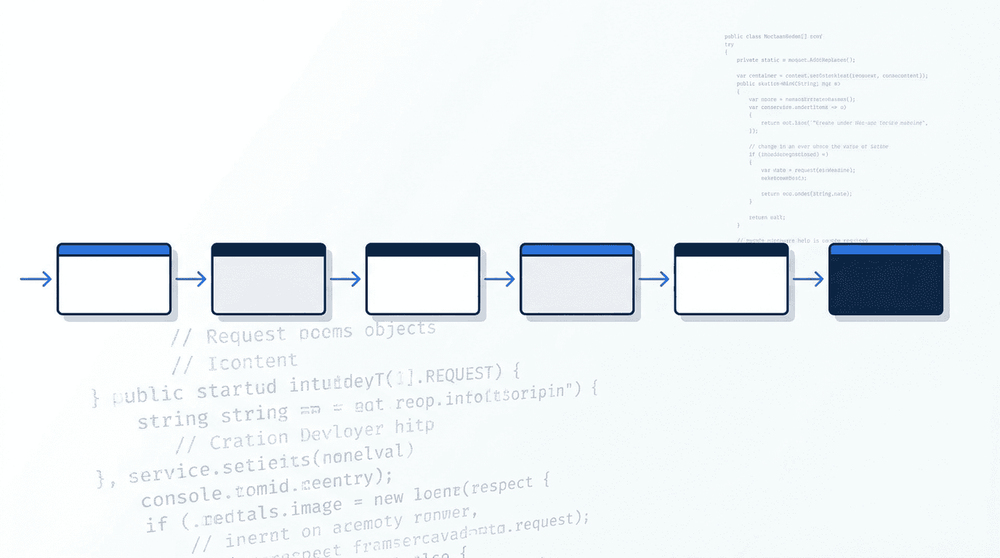
In Express.js, every incoming HTTP request travels through a chain of middleware functions before a response is sent. Each function in the chain receives the request and response objects, performs its task—such as parsing a request body, checking authentication, or logging—and then either ends the response or passes control to the next function via next(). This linear, ordered execution model makes the request lifecycle predictable and easy to reason about, and allows complex behavior to be composed from small, focused units.
One of Express's most cited strengths is its minimalism. The framework ships with a small, focused core, which means applications only include the dependencies they actually need. This keeps bundle sizes manageable and avoids the overhead that comes with full-stack frameworks that bundle features regardless of whether a project uses them. For teams that want precise control over their stack, this is a meaningful advantage.
Express also benefits from a large and mature ecosystem. Because it has been in active use since 2010, a wide range of middleware packages exist for common needs: authentication, request validation, rate limiting, session management, and logging, among others. Most of these are well-documented and straightforward to integrate via npm. The size of the community also means that solutions to common problems are easy to find, and the framework itself is well-understood by a large portion of the Node.js developer base.
The framework's flexibility, however, is a double-edged quality. Because Express imposes no conventions on project structure, teams must make their own architectural decisions — how to organize routes, where to place business logic, how to handle errors consistently, and how to structure middleware chains. In small projects, this freedom is unproblematic. In larger codebases or teams, the absence of a standard structure can lead to inconsistency and maintenance difficulties if those decisions are not made deliberately and documented clearly.
There are also security considerations that stem from Express's unopinionated nature. Common protections — such as input sanitization, HTTP security headers, and CSRF mitigation — are not included by default and must be added manually through middleware like Helmet or custom validation layers. Developers unfamiliar with these requirements may overlook them. This places a higher burden on the team compared to frameworks that enforce or include sensible security defaults out of the box.
Comparison of common Node.js frameworks across structure, performance, and ecosystem size. Choices depend on project scale, team conventions, and throughput requirements.

Express.js is most commonly used to build REST API servers that handle requests from web or mobile frontends, making it a natural fit for single-page application backends. Its middleware architecture also makes it a practical choice as a thin routing and request-processing layer in larger service-oriented systems. Development teams frequently reach for Express when prototyping new ideas quickly, since minimal configuration means a working HTTP server can be running within minutes.
Express.js is a minimal, unopinionated web framework for Node.js that provides the core tools—routing, middleware, and HTTP utilities—needed to build server-side applications without prescribing how to structure them. It fits best in projects that benefit from flexibility: REST APIs, backend services, and lightweight web servers where a team wants control over architecture rather than a framework-imposed convention. Its low abstraction overhead makes it straightforward to understand and debug, which partly explains its longevity in a JavaScript ecosystem that has seen many frameworks come and go.
Despite the emergence of more opinionated alternatives such as NestJS and newer runtimes like Deno with their own HTTP libraries, Express continues to see widespread adoption because of its stability, its enormous ecosystem of compatible middleware, and the sheer volume of existing knowledge and documentation available for it. For teams already familiar with Node.js, the learning curve is shallow, and the framework's predictable behavior in production remains a practical advantage. It is not the right choice for every project—applications requiring built-in structure, GraphQL-first design, or real-time communication at scale may be better served by more specialized tools—but as a foundation for HTTP-based services in JavaScript, Express remains a well-established and reliable option.