Technologies
GraphQL

GraphQL is a query language for APIs and a server-side runtime for executing those queries against a defined type system. It was developed internally at Facebook starting in 2012 and released as an open specification in 2015. Unlike REST, which exposes multiple endpoints each returning fixed data structures, GraphQL exposes a single endpoint through which clients can request exactly the fields they need — no more, no less. This precise data-fetching model was designed to address the over-fetching and under-fetching problems that commonly arise in complex, data-rich client applications.
At its core, GraphQL consists of two parts: a schema definition language (SDL) used to describe the types and relationships in an API, and a runtime that validates and executes incoming queries against that schema. The schema acts as a contract between the client and the server, making the entire API self-documenting and introspectable. Because every query is validated against the schema before execution, type errors are caught early rather than at runtime. This combination of strong typing, introspection, and client-driven queries has made GraphQL a widely adopted alternative to REST in modern web and mobile development.
GraphQL was developed internally at Facebook in 2012 as a response to the limitations that REST APIs presented when building complex, data-intensive mobile applications. Engineers needed a way for clients to request precisely the data they required — no more, no less — and to fetch multiple related resources in a single network call. The query language was designed to address these needs directly, and it quickly became a core part of how Facebook's mobile clients communicated with their backend services.
After several years of internal use, Facebook open-sourced GraphQL in 2015, releasing both the specification and a reference implementation. The move prompted rapid adoption across the industry, with companies building their own server and client libraries in numerous programming languages. In 2018, governance of the specification was transferred to the GraphQL Foundation, a neutral, vendor-independent body hosted under the Linux Foundation, ensuring that the project's development would be guided by broad community input rather than any single organization.
At the core of every GraphQL API is a schema, written in the Schema Definition Language (SDL). The schema defines all the types available in the API — objects, their fields, and the data types those fields return, such as strings, integers, booleans, or other objects. Clients interact with the schema through three operation types: query for reading data, mutation for writing data, and subscription for receiving real-time updates. Because every field and type is explicitly declared, the schema acts as both a contract between client and server and a source of introspection that tooling can use to provide autocompletion and validation.
When a client sends a query, it specifies exactly which fields it wants, nesting them to follow relationships between types. On the server side, each field in the schema is backed by a resolver — a function responsible for fetching or computing that field's value, whether from a database, a REST endpoint, or any other data source. The GraphQL execution engine walks the query tree, calls the relevant resolvers, and assembles the results into a single response that mirrors the shape of the request. This means a client can retrieve data from multiple related resources in one round trip, receiving only the fields it asked for — no more, no less.
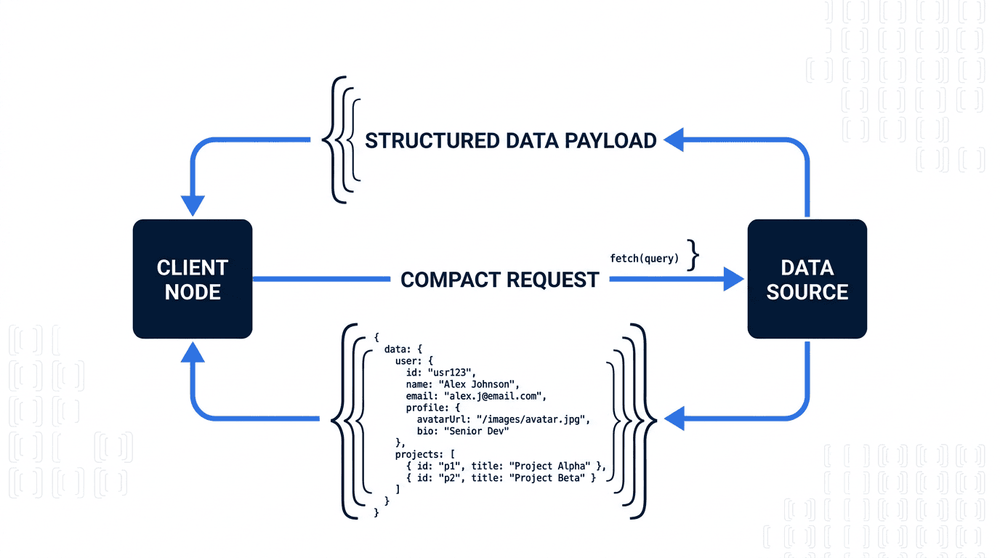
In a typical REST architecture, fetching a user's profile along with their posts and comments requires hitting three separate endpoints. Each request adds latency and forces the client to stitch data together. With GraphQL, a single query describes all three resources as nested fields, and the server returns exactly that shape in one response. The difference is significant in mobile environments where connection quality is inconsistent and round-trip cost is high.
One of GraphQL's most cited advantages is precise data fetching. Because clients specify exactly which fields they need in a query, the server returns only that data — nothing more, nothing less. This eliminates the two problems common in REST APIs: over-fetching, where a response contains more data than the client needs, and under-fetching, where a client must make multiple requests to assemble the data it actually requires. For applications with constrained bandwidth or complex data needs, this precision translates directly into better performance and less wasted work.
GraphQL also enforces a strongly typed schema that acts as a contract between client and server. Every type, field, and relationship is defined explicitly in the schema, which enables tooling support such as autocompletion and static analysis. Closely related is the introspection capability: clients can query the API itself to discover what types and operations are available. Combined with a single endpoint that handles all operations — queries, mutations, and subscriptions — this makes GraphQL APIs generally easier to explore and document than their REST counterparts.
The tradeoffs are real, however. HTTP-level caching is significantly more difficult with GraphQL than with REST. REST APIs benefit naturally from HTTP caching because each resource has a distinct URL; in GraphQL, all requests go through a single POST endpoint, which breaks standard cache mechanisms. Teams that need caching must implement it at the application layer — for example, through persisted queries or a dedicated caching library — which adds complexity compared to the REST baseline.
There is also the problem of query cost and abuse. Because clients can compose arbitrarily complex queries, a single malformed or malicious request can trigger deeply nested resolvers and put significant load on the server. Protecting against this requires query depth limiting, cost analysis, or rate limiting — none of which are built into GraphQL itself. Finally, the learning curve should not be underestimated: teams accustomed to REST need to internalize a new mental model, schema design conventions, and resolver patterns before becoming productive. For small projects with simple data requirements, the added complexity may not be justified.
A comparison of GraphQL and REST across key technical dimensions to help teams choose the right approach for their project.
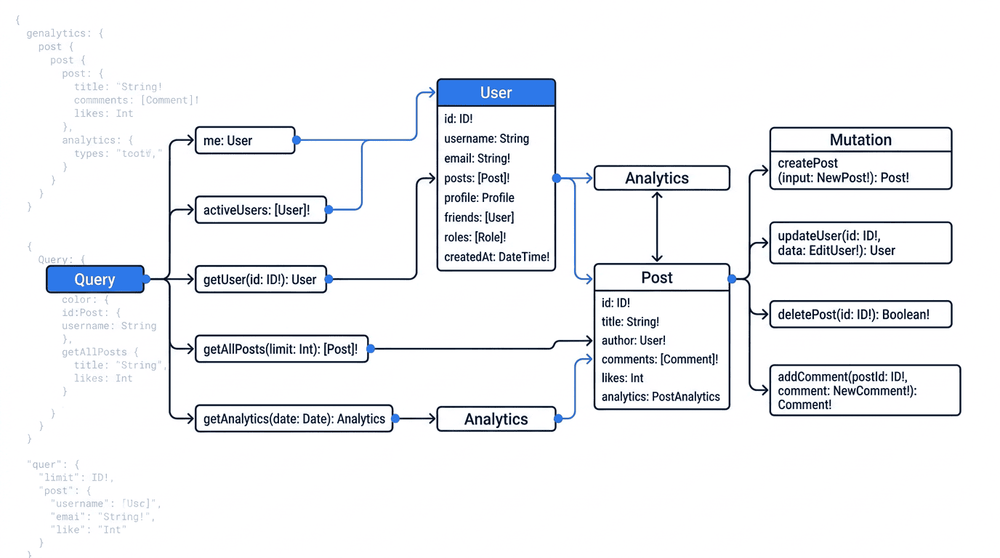
GraphQL is a strong fit when clients have complex or variable data requirements, such as mobile applications that need to minimize payload size over constrained connections. It also excels when a single API must aggregate data from multiple backend services—resolvers can fan out to different sources and return a unified response. Teams building products with several distinct client types, each needing different data shapes from the same endpoint, consistently benefit from the flexibility GraphQL's query model provides.
GraphQL is a query language and runtime for APIs that gives clients precise control over the data they request, eliminating the over-fetching and under-fetching problems common in REST-based architectures. Its strongly typed schema serves as a contract between client and server, enabling better tooling, predictable responses, and easier API evolution through features like field deprecation. These characteristics make it a strong fit for projects where multiple client types—web, mobile, third-party integrations—consume the same API but require different data shapes.
The tradeoffs are real and worth weighing carefully. GraphQL introduces complexity in caching, query cost analysis, and server-side implementation that REST does not carry by default. For simpler APIs with a small number of well-defined endpoints, or for teams without existing GraphQL experience, the overhead may outweigh the benefits. Where it genuinely excels is in data-rich, client-diverse environments where flexibility and developer experience are priorities—and where the team is prepared to manage the tooling and governance that a schema-first API requires.