Technologies
MongoDB

MongoDB is a document-oriented NoSQL database that stores data as flexible, JSON-like documents rather than in the fixed rows and columns of a relational table. Each document is encoded in BSON (Binary JSON), a binary representation that extends JSON to support additional data types such as dates and binary data. Because documents within the same collection do not need to share an identical structure, MongoDB accommodates evolving data models without requiring schema migrations in advance.
Developed by MongoDB, Inc. and first released in 2009, the database was designed to address scalability and flexibility challenges that rigid relational schemas made difficult. It is open-source under the Server Side Public License (SSPL), with a commercial Atlas managed-service offering available on major cloud platforms. MongoDB is widely used across a broad range of application types, from content management systems to real-time analytics pipelines, wherever the ability to store heterogeneous or hierarchical data in a single record is an advantage over a normalized, table-based approach.
MongoDB was created by engineers at 10gen, a software company founded in 2007 with the initial goal of building a platform-as-a-service product. During development, the team encountered the limitations of existing relational databases when dealing with large-scale, flexible data requirements, and shifted focus toward building a database engine that could handle those demands natively. The database component of that work was separated out and released as an open-source project in 2009 under the name MongoDB — a name derived from the word "humongous", reflecting its intended capacity for handling large volumes of data.
Following its open-source release, MongoDB gained rapid adoption among developers building web applications that needed flexible schemas and horizontal scalability. In 2013, 10gen rebranded itself as MongoDB, Inc., signaling that the database had become the company's primary focus. Over the following years, MongoDB expanded its ecosystem with cloud hosting, enterprise tooling, and a managed database service known as MongoDB Atlas, establishing itself as one of the most widely deployed NoSQL databases in production environments worldwide.
MongoDB organizes data into collections and documents, rather than the tables and rows familiar from relational databases. A document is a self-contained record expressed as a set of key-value pairs, where values can be strings, numbers, arrays, booleans, or even nested documents. This nested structure means that related data can be stored together in a single document, eliminating the need for joins that are common in SQL databases. Collections group documents of a similar kind, though unlike relational tables, MongoDB does not enforce a fixed schema—documents in the same collection can have different fields.
Internally, MongoDB stores documents in BSON (Binary JSON), a binary-encoded format that extends JSON with additional data types such as dates, binary data, and 64-bit integers. BSON is more compact and faster to parse than plain text JSON, which benefits both storage and transmission. Querying in MongoDB is document-oriented: filters are expressed as JSON-like objects that match against fields and values. To maintain query performance at scale, MongoDB supports a range of indexes—including single-field, compound, geospatial, and text indexes—that allow the database engine to locate matching documents without scanning entire collections.
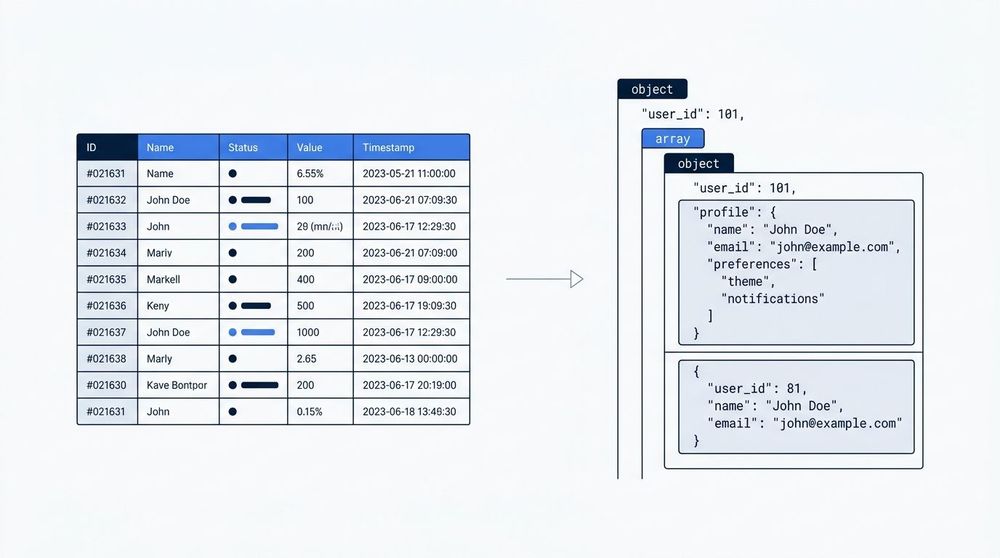
In a relational database, data lives in tables with fixed columns and rows. MongoDB replaces this structure with a hierarchy of databases, collections, and documents. A collection loosely resembles a table, but each document within it can carry its own set of fields—no shared schema is enforced. This flexibility means related data can be nested directly inside a single document rather than spread across multiple joined tables.
One of MongoDB's most cited advantages is its schema flexibility. Because documents in a collection are not required to share the same structure, teams can iterate on a data model without coordinating schema migrations across an entire table. This is particularly useful in early-stage development, when requirements change frequently, or when different records in the same collection legitimately carry different fields. The document model also maps naturally to objects in application code, reducing the translation layer between the database and the application.
MongoDB is designed for horizontal scalability through a built-in mechanism called sharding, which distributes data across multiple servers or clusters. This allows a MongoDB deployment to grow by adding nodes rather than upgrading a single machine, making it well-suited for applications that must handle large data volumes or high write throughput. Alongside sharding, MongoDB's replica sets provide redundancy and automatic failover, so the database can remain available if a node goes offline. The query language is also expressive, supporting filtering, projection, aggregation pipelines, geospatial queries, and full-text search within the same system.
The primary disadvantages center on resource consumption and consistency guarantees. MongoDB tends to use more memory than relational databases for comparable workloads because it stores data in BSON documents with repeated field names and maintains in-memory working sets for performance. Historically, multi-document ACID transactions were not supported, which made it difficult to enforce consistency across related records — for example, debiting one account and crediting another atomically. MongoDB introduced multi-document ACID transactions in version 4.0 (2018) for replica sets and extended them to sharded clusters in version 4.2, but using them adds overhead and is not as natural as in a relational database built around transactions from the start.
Eventual consistency is another area where MongoDB requires careful configuration. Read operations directed at secondary replica set members can return slightly stale data, since replication is asynchronous by default. Applications that require strong read-after-write consistency must configure read and write concerns explicitly — using options such as writeConcern: majority and readConcern: linearizable — which increases latency. Teams that overlook these defaults can encounter subtle data consistency bugs that are harder to diagnose than the constraints violations a relational database would surface immediately.
A side-by-side comparison of MongoDB, PostgreSQL, Cassandra, and Redis across data model, scalability approach, and consistency model.
MongoDB is well suited to content management systems and product catalogs where each record may carry a different set of attributes. A catalog of consumer electronics, for instance, might store dozens of fields for a laptop—processor specs, display resolution, battery capacity—while a clothing item requires entirely different attributes like size, color, and material. Because MongoDB stores each document as a self-contained structure rather than enforcing a fixed table schema, these heterogeneous records can coexist in a single collection without null-filled columns or separate tables for every product type.
Beyond content and catalog workloads, MongoDB is commonly used as a mobile and web application backend where data models evolve quickly during early development. Teams can add or restructure fields across documents without running schema migration scripts, which reduces friction during rapid iteration. MongoDB also appears frequently in real-time analytics pipelines and event-logging systems, where high write throughput and flexible document structures make it straightforward to ingest and query streams of user activity, sensor readings, or application telemetry.
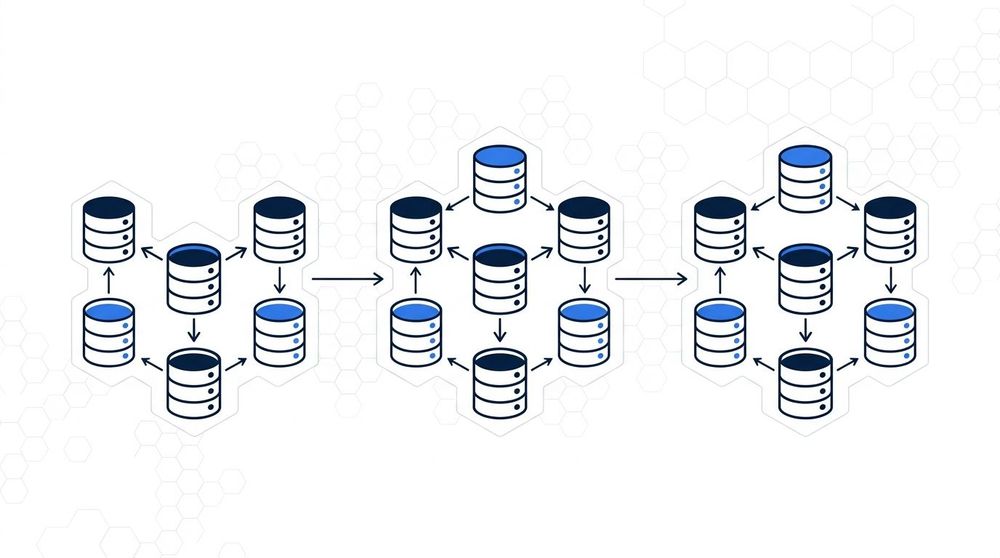
A typical MongoDB deployment combines replica sets with horizontal sharding to achieve both high availability and elastic scale. Each replica set holds a primary node that accepts writes and one or more secondaries that replicate data and can serve reads. When traffic or data volume grows beyond what a single set can handle, a sharded cluster distributes documents across multiple shards using a configurable shard key. A query router (mongos) directs operations to the correct shard, keeping the topology transparent to the application.
MongoDB's document model sets it apart from relational databases by storing data as flexible, self-contained JSON-like documents rather than rows spread across normalized tables. This design naturally accommodates hierarchical and variable-structure data, and its horizontal scaling capabilities—through sharding and replica sets—make it well-suited for applications that must handle large volumes of reads and writes or unpredictable growth. Projects such as content management systems, real-time analytics platforms, user profile stores, and event-driven applications are areas where MongoDB's strengths align closely with what the workload demands.
That said, MongoDB is not a universal replacement for relational databases. Workloads that depend on complex multi-table joins, strict transactional integrity across many entities, or highly normalized data models will generally find a relational system like PostgreSQL a more natural fit. The practical choice comes down to data shape, consistency requirements, and query patterns: where documents map cleanly to the domain and schema flexibility is an asset, MongoDB performs well; where referential integrity and structured relationships are central, a relational database remains the stronger option.
