Technologies
MySQL

MySQL is an open-source relational database management system (RDBMS) that organizes data into structured tables and uses Structured Query Language (SQL) to query, insert, update, and delete records. Originally released in 1995 by Swedish company MySQL AB, it has grown into one of the most widely deployed database systems in the world, used by applications ranging from small websites to large-scale enterprise platforms. It is currently maintained and distributed by Oracle Corporation, though a community edition remains freely available under the GNU General Public License.
In modern software development, MySQL serves as the data persistence layer in a wide range of application architectures. It is a foundational component of the LAMP stack (Linux, Apache, MySQL, PHP/Perl/Python), which has underpinned a large portion of the web since the early 2000s, and it continues to appear in contemporary stacks alongside frameworks like Node.js, Django, and Ruby on Rails. Its combination of broad platform support, mature tooling, and well-understood behavior makes it a common default choice when an application requires a structured, queryable store of relational data.
MySQL was created by Swedish developers Michael Widenius and David Axmark, with the first internal version released in 1995 and a public release following in 1996. The name combines "My", after Widenius's daughter, with SQL, the standard query language the database uses. MySQL AB, the company founded to develop and support the database, made it available under a dual-license model — open source for community use and commercial licenses for proprietary applications. This approach helped MySQL grow rapidly throughout the late 1990s and into the 2000s, particularly as a core component of the LAMP stack (Linux, Apache, MySQL, PHP/Perl/Python) that powered much of the early web.
Sun Microsystems acquired MySQL AB in 2008 for approximately one billion US dollars, and Oracle Corporation in turn acquired Sun in 2010, bringing MySQL under Oracle's stewardship. The acquisition raised concerns in the open source community about MySQL's future development direction and licensing. In response, Michael Widenius forked the codebase in 2009 to create MariaDB, a community-developed drop-in replacement designed to remain fully open source under the GNU General Public License. MariaDB has since diverged from MySQL in several respects, adding its own storage engines and features, and is maintained by the MariaDB Foundation.
MySQL follows a client-server architecture in which client applications send SQL statements over a network connection to a MySQL server process, which parses, optimizes, and executes each query before returning results. Data is organized into tables — two-dimensional structures of rows and columns — grouped within named databases. Each table is governed by a defined schema that specifies column names, data types, and constraints such as primary keys, foreign keys, and uniqueness rules. This schema-on-write model means the database enforces data integrity at the storage level, before any application logic runs.
The specific behavior of how MySQL reads and writes data depends on the storage engine assigned to each table. InnoDB is the default engine and supports ACID-compliant transactions, row-level locking, and foreign key constraints, making it suitable for most production workloads. MyISAM, an older engine, offers faster read performance in some scenarios but lacks transaction support and uses table-level locking, which limits write concurrency. When a client issues a SELECT query, MySQL's query optimizer evaluates available indexes and chooses an execution plan intended to minimize the number of rows examined, returning the matching result set to the client.
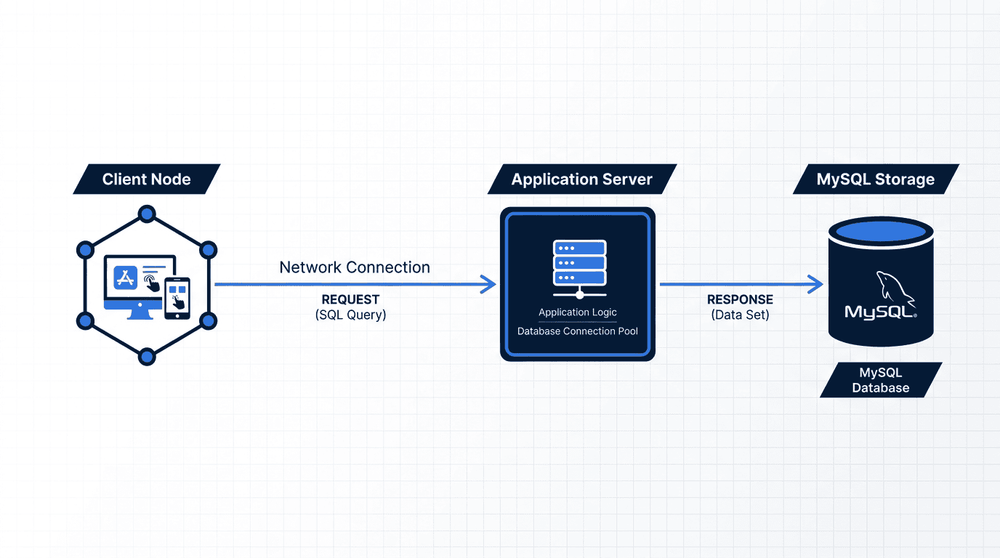
MySQL operates on a client-server model. Client applications—whether a web application, a command-line tool, or a database GUI—send SQL queries over a network connection to the MySQL server process. The server parses and executes those queries, then delegates reads and writes to the appropriate storage engine, such as InnoDB or MyISAM. This separation means multiple clients can interact with the same database concurrently, while the server manages authentication, query optimization, and transaction coordination centrally.
One of MySQL's most significant strengths is its performance under read-heavy workloads. Its storage engine architecture, particularly the InnoDB engine, is optimized for fast SELECT queries and concurrent reads, making it well-suited for web applications that retrieve data far more often than they write it. MySQL also has a long track record of stability, which translates into a large body of operational knowledge, documented best practices, and experienced administrators available in the job market.
MySQL benefits from broad ecosystem support. It is included by default or supported out of the box in virtually every major web hosting environment, cloud platform (including AWS RDS, Google Cloud SQL, and Azure Database for MySQL), and application framework. Tooling such as MySQL Workbench, phpMyAdmin, and numerous CLI clients makes administration and schema management accessible to developers at a range of experience levels. This ubiquity reduces the friction of finding compatible drivers, ORMs, or deployment infrastructure.
On the disadvantage side, MySQL's conformance to the SQL standard is incomplete in certain areas. Features such as full support for common table expressions (CTEs), window functions, and CHECK constraint enforcement were absent or limited in older versions and only added incrementally in MySQL 8.0. Applications that rely on strict SQL standards compliance or advanced analytical query patterns may encounter gaps that require workarounds, or may be better served by a database system designed with those features at its core.
MySQL's horizontal scaling story also has real constraints. While replication setups (primary/replica) work well for distributing read traffic, multi-primary write scaling is complex to configure and maintain correctly. For applications that require very high write throughput distributed across nodes, or that need to scale beyond a single writable primary without significant architectural effort, MySQL can become a limiting factor. Purpose-built distributed databases or NewSQL systems are often better choices at that scale.
Comparison of MySQL, PostgreSQL, and SQLite across license, ACID compliance, scalability, and common use cases.
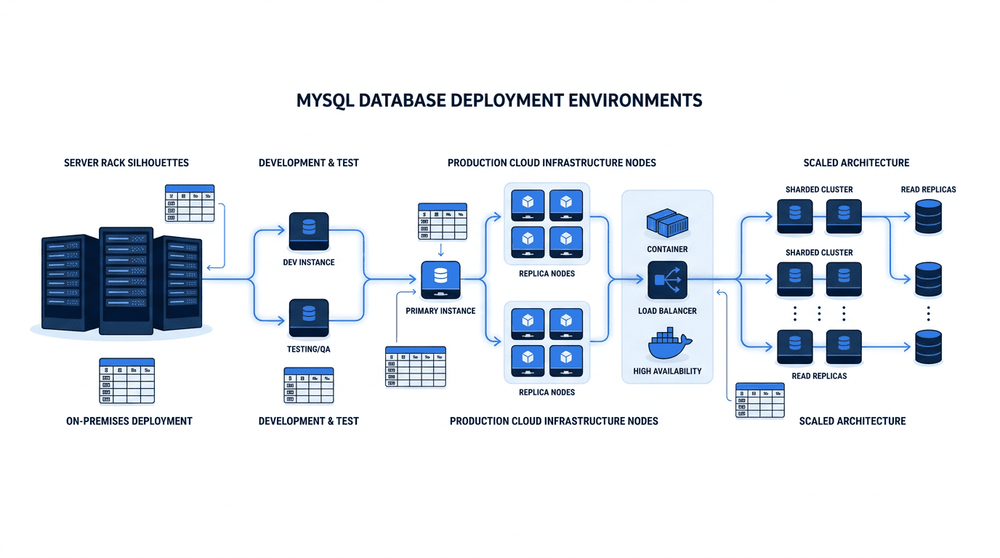
MySQL is a common choice for web applications that require reliable relational data storage at scale. Content management systems such as WordPress, Drupal, and Joomla rely on MySQL as their default database engine. E-commerce platforms use it to manage product catalogs, order records, and customer data. Its query optimizer also makes it well suited to read-heavy workloads, where many concurrent users retrieve data more often than they write it.
MySQL remains one of the most widely deployed relational database systems in the world, underpinning everything from small web applications to large-scale production platforms. Its combination of proven reliability, broad driver and tooling support, and active community maintenance through both Oracle's commercial releases and the MariaDB fork gives it a durable place in the technology landscape. The storage engine architecture, mature replication capabilities, and compatibility with virtually every major programming language mean that teams can integrate MySQL into a wide range of project types without significant friction.
That said, MySQL is not a universal answer. Applications requiring complex document storage, graph traversals, or horizontal write scaling at very large volumes may be better served by purpose-built databases. Within its intended domain—structured, relational data with well-defined schemas and transaction requirements—MySQL continues to be a practical and well-understood choice, with decades of operational knowledge available in documentation, community forums, and professional literature.
