Technologies
NestJS

NestJS is a progressive Node.js framework for building efficient and scalable server-side applications. It is written in TypeScript and, while it compiles down to plain JavaScript, it is designed to take full advantage of TypeScript's type system and modern language features. NestJS draws heavily on concepts from Angular, introducing a modular architecture, decorators, and dependency injection to the server side — patterns that are common in enterprise front-end development but had no clear equivalent in the Node.js ecosystem before NestJS appeared.
Under the hood, NestJS is built on top of established HTTP server libraries — by default Express, with optional support for Fastify — so it inherits a large ecosystem of compatible middleware and plugins. The framework organises application code into modules, controllers, and providers, enforcing a clear separation of concerns that makes large codebases easier to maintain and test. This structured approach distinguishes NestJS from more minimal Node.js frameworks and makes it a common choice for teams building complex, long-lived backend services.
NestJS was created by Kamil Myśliwiec, a Polish software engineer who released the first version in 2017. His motivation was to address a gap in the Node.js ecosystem: while frameworks like Express gave developers a fast, unopinionated foundation for building server-side applications, they provided little guidance on how to structure larger codebases. As applications grew in complexity, teams were left to devise their own conventions for dependency injection, module boundaries, and separation of concerns — often inconsistently. Myśliwiec drew inspiration from Angular, adopting its decorator-based syntax and modular architecture to bring a similar level of structural discipline to the backend.
The result was a framework that layers a strongly opinionated architecture on top of Node.js runtimes, using TypeScript as its primary language by default. NestJS does not replace the underlying HTTP layer — it can run on top of Express or Fastify — but it imposes a consistent pattern for how code is organized into modules, controllers, providers, and services. This approach was aimed squarely at teams building enterprise-scale applications that needed maintainability and testability from the outset, rather than patterns that emerged informally over time.

NestJS organizes application code into self-contained modules, each grouping related controllers and providers. Controllers handle incoming HTTP requests and return responses, while providers—typically services—contain the business logic injected via NestJS's built-in dependency injection system. Modules declare which controllers and providers they own, and can export providers for use in other modules. This explicit structure keeps large codebases navigable and enforces clear boundaries between features.
NestJS organizes application code into modules, which are classes decorated with @Module() that group related controllers and providers together. Each application has at least one root module, and larger applications typically break functionality into feature modules — for example, a separate module for authentication, another for users, and another for database access. This modular boundary makes it straightforward to reason about which parts of the codebase depend on which, and it allows modules to be reused or replaced independently without disturbing unrelated parts of the system.
Within a module, controllers handle incoming HTTP requests and are declared with the @Controller() decorator, while providers — such as services and repositories — encapsulate business logic and data access, declared with @Injectable(). NestJS's built-in dependency injection system wires these pieces together at runtime: a controller that needs a service simply declares it as a constructor parameter, and the NestJS IoC container resolves and injects the correct instance automatically. This pattern reduces manual wiring, makes unit testing straightforward through easy substitution of mock providers, and keeps individual classes focused on a single responsibility.
One of NestJS's most significant advantages is its first-class TypeScript support. Because the framework is built in TypeScript from the ground up, developers benefit from static type checking, autocompletion, and compile-time error detection across the entire application. This reduces a wide class of runtime bugs and makes large codebases considerably easier to navigate and maintain over time, particularly when multiple developers are working on the same project.
NestJS also imposes strong, opinionated conventions on project structure. By prescribing how modules, controllers, providers, and services should be organized, the framework eliminates a great deal of architectural decision-making that otherwise falls to individual teams. This consistency pays dividends as applications grow: a developer joining an existing NestJS project can orient themselves quickly because the layout and patterns are predictable. The built-in dependency injection system reinforces this by making component relationships explicit and easy to reason about. Testability follows naturally from the same design — because dependencies are injected rather than hard-coded, individual units can be isolated and tested in isolation without significant mocking overhead.
The framework's primary drawback is its steep learning curve. Developers coming from plain Node.js or minimalist frameworks like Express must absorb a considerable amount of new conceptual territory — decorators, modules, providers, guards, interceptors, and pipes all need to be understood before the overall architecture makes sense. The heavy use of decorators, which are a TypeScript-specific (and still-evolving) language feature, can feel unfamiliar and adds a layer of indirection that takes time to become comfortable with.
Related to this is the issue of abstraction overhead. NestJS introduces multiple layers between a developer's code and the underlying HTTP runtime, which can make debugging less straightforward — a problem appearing at the HTTP layer may require tracing through several framework abstractions before its source is clear. For small projects or simple APIs, this overhead may outweigh the organizational benefits the framework provides, making lighter alternatives a more practical choice in those contexts.
Comparison of NestJS, Express, and Fastify across structure, TypeScript support, performance, and learning curve.
NestJS is most commonly used to build RESTful APIs and GraphQL servers for web and mobile applications. Its module system makes it straightforward to organize complex API surfaces into coherent domains, while built-in support for validation, serialization, and authentication middleware reduces the amount of boilerplate a team needs to write. For GraphQL in particular, NestJS provides a dedicated @nestjs/graphql package that integrates with Apollo Server and supports both code-first and schema-first approaches, allowing teams to choose the workflow that fits their existing conventions.
Beyond single-service APIs, NestJS sees significant adoption in microservices architectures and enterprise-grade backend systems. The framework ships with a dedicated transport layer that supports message brokers such as Redis, RabbitMQ, and Kafka, enabling services to communicate asynchronously without requiring external orchestration libraries. This combination of structured architecture, TypeScript type safety, and first-class support for distributed messaging patterns makes NestJS a practical choice for larger engineering teams building systems that need to scale across multiple independent services.
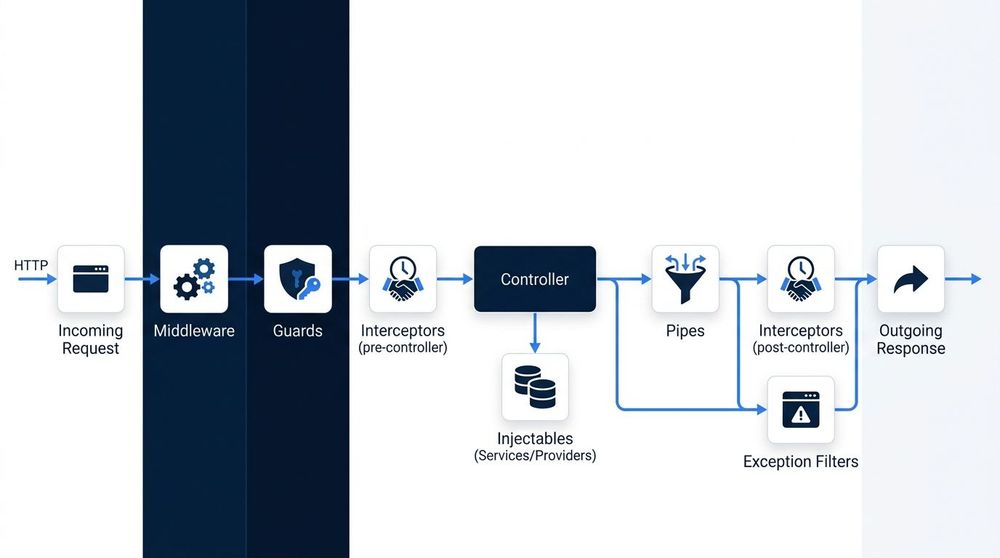
When an HTTP request arrives at a NestJS application, it passes through a well-defined sequence of layers before reaching the controller handler. Middleware runs first, handling tasks like logging or body parsing. Guards evaluate whether the request should proceed, enforcing authentication and authorization rules. Interceptors then wrap the handler execution, allowing pre- and post-processing logic. Pipes validate and transform incoming data at the parameter level. Only after all these layers have been traversed does the controller method execute and return a response.
NestJS occupies a distinct position in the Node.js ecosystem by bringing a strongly opinionated, architecture-first approach to a runtime that has traditionally left structural decisions to individual developers. Its module system, dependency injection container, and decorator-based syntax draw directly from Angular, giving teams a consistent mental model whether they are building REST APIs, GraphQL services, or event-driven microservices. That consistency comes at a cost — the abstraction layers add complexity, the learning curve is steeper than that of minimalist frameworks like Express or Fastify, and applications that start simple can accumulate boilerplate as they grow.
For teams and projects where those tradeoffs are acceptable — particularly larger codebases, distributed service architectures, or organizations that value enforced conventions over flexible freedom — NestJS provides real structural benefits that become more valuable over time. Its TypeScript-first design, broad ecosystem of built-in modules, and alignment with proven object-oriented patterns make it a durable foundation for long-running backend projects. Developers evaluating Node.js backend frameworks will find NestJS most compelling when maintainability and team scalability matter as much as raw simplicity.