Technologies
Node.js

Node.js is an open-source, cross-platform server-side JavaScript runtime environment built on the V8 JavaScript engine developed by Google for the Chrome browser. By embedding V8 outside of the browser, Node.js allows JavaScript code to be executed directly on a server or any other host machine, rather than being confined to a client-side web context. This made it possible, for the first time, for developers to use JavaScript as a general-purpose language on both the front end and the back end of an application.
Node.js uses an event-driven, non-blocking I/O model, which means it handles operations such as reading files, querying databases, or making network requests asynchronously—without halting the execution of other code while waiting for a response. This architecture makes Node.js particularly well-suited to building applications that must handle a large number of concurrent connections, such as APIs, real-time services, and streaming platforms. Its package ecosystem, managed through the npm (Node Package Manager) registry, has grown into one of the largest collections of open-source libraries available for any programming language.
Node.js was created by Ryan Dahl and first released in 2009. Dahl built it to address a fundamental limitation he observed in existing server-side environments: the inability to handle concurrent connections efficiently without blocking. By embedding Google's V8 JavaScript engine — originally designed for the Chrome browser — into a standalone runtime, he made it possible to run JavaScript outside the browser and execute I/O operations in a non-blocking, event-driven manner. The project was initially sponsored by Joyent, where Dahl worked at the time.
In 2014, a group of contributors frustrated with the pace of development and governance of the project forked the codebase to create io.js, which shipped more frequent releases and incorporated newer V8 features faster. The split proved short-lived: in 2015, io.js and Node.js merged back together under the newly formed Node.js Foundation, which established an open governance model and a Long Term Support (LTS) release schedule. The Foundation later merged with the JS Foundation in 2019 to become the OpenJS Foundation, which continues to oversee Node.js development today.
At the core of Node.js is its event-driven, non-blocking I/O model, which determines how it handles concurrent operations. Rather than assigning a dedicated thread to each incoming request — as traditional server models do — Node.js processes all requests on a single thread and delegates slow operations, such as file reads or database queries, to the operating system. When one of those operations completes, the OS notifies Node.js via a callback, allowing the main thread to pick up the result without having been blocked while waiting.
The mechanism that makes this possible is the event loop, a continuously running process that checks a queue of completed operations and dispatches the associated callbacks in order. Because I/O work happens outside the main thread, the event loop remains free to accept and route new requests in the meantime. This design means Node.js can handle a large number of simultaneous connections with relatively low memory overhead, though it also means that CPU-intensive tasks — which do occupy the main thread — can block the event loop and degrade responsiveness for all concurrent requests.

Node.js processes all requests on a single thread, relying on the event loop to manage asynchronous operations without blocking execution. When an I/O operation is initiated—such as a database query or file read—Node.js registers a callback and moves on to the next task. Once the operation completes, the callback is placed in the event queue and executed in turn. This model avoids the overhead of spawning a new thread per request, making Node.js well-suited for applications with high concurrency and frequent I/O.
One of Node.js's most significant strengths is its ability to handle a large number of concurrent connections with minimal overhead. Because it uses a non-blocking, event-driven I/O model, a single Node.js process can manage thousands of simultaneous connections without spawning a new thread for each one. This makes it particularly well-suited to network-intensive workloads such as real-time APIs, chat servers, and streaming applications where I/O operations dominate and requests spend most of their time waiting rather than computing.
A second practical advantage is the ability to use JavaScript across the entire stack—both in the browser and on the server. Teams can share code, data models, and validation logic between the front end and back end, which reduces duplication and lowers the cognitive overhead of context-switching between languages. This is reinforced by the npm ecosystem, which provides access to an enormous library of open-source packages, allowing developers to integrate functionality quickly without building everything from scratch.
Node.js does, however, have well-documented limitations. Its single-threaded event loop means that CPU-bound tasks—such as complex mathematical computations, image processing, or heavy cryptographic operations—can block the event loop and degrade performance for all concurrent requests. Worker threads mitigate this to some degree, but Node.js is generally not the optimal choice for applications where the bottleneck is computation rather than I/O.
Historically, deeply nested asynchronous callbacks—often referred to as callback hell—made Node.js code difficult to read and maintain. The introduction of Promises and the async/await syntax has substantially improved this situation, but developers still need to apply consistent patterns around error handling in asynchronous code. In large codebases, inconsistent async handling remains a source of subtle bugs that can be harder to trace than equivalent synchronous errors.
Comparison of Node.js against common server-side runtimes across concurrency model, performance profile, and ecosystem maturity. Each runtime has distinct strengths suited to different workload types.
Node.js performs particularly well in scenarios that require handling many simultaneous connections with low latency. Real-time applications such as chat platforms, collaborative editing tools, and live notification systems benefit directly from Node.js's event-driven architecture, which can maintain thousands of open connections without the overhead of spawning a new thread for each one. Similarly, REST APIs and GraphQL servers are a natural fit, since the non-blocking I/O model keeps response times short even under high request volumes. These characteristics have made Node.js a common choice for the backend layer of single-page applications where the frontend and server share JavaScript code.
Beyond APIs and real-time communication, Node.js is well-suited to streaming services that process data incrementally rather than loading it all into memory at once — video streaming, file uploads, and log processing pipelines all fall into this category. It is also widely adopted in microservices architectures, where small, independently deployable services communicate over HTTP or message queues; Node.js's lightweight footprint and fast startup time make each service inexpensive to run and scale. Build tooling — bundlers, test runners, and CLI utilities — represents another prominent use case, given that the Node.js ecosystem includes npm, one of the largest package registries available to developers.
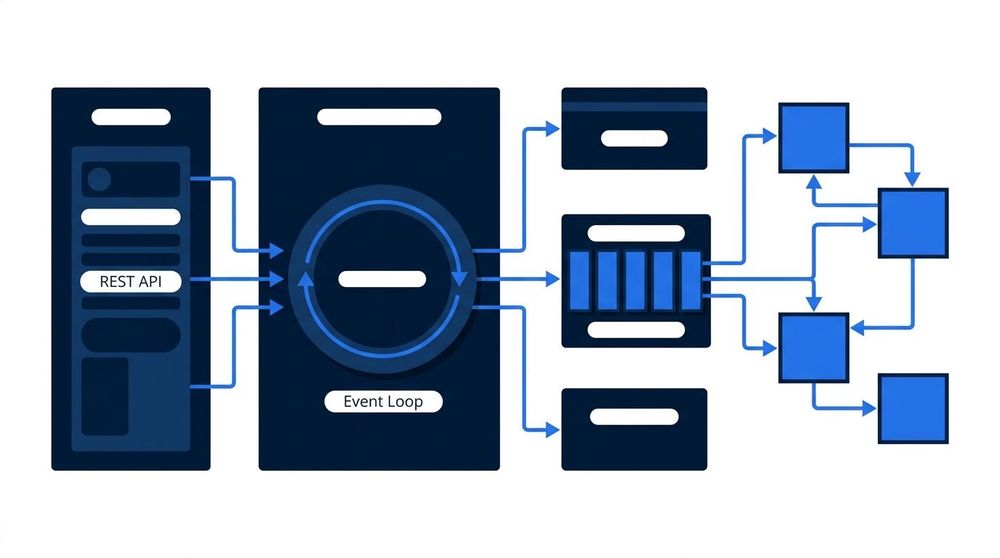
In a microservices setup, a Node.js API gateway receives incoming HTTP requests and routes them to specialized downstream services—authentication, data access, notification, and so on. Services communicate over HTTP/REST or message queues such as RabbitMQ or Kafka, with each service running its own Node.js process. This separation keeps individual services small and independently deployable. Node.js fits naturally into this pattern because its non-blocking I/O handles many concurrent inter-service connections without the thread-per-request overhead common in traditional server models.
Node.js ships with npm (Node Package Manager), which serves as the default package manager for the platform and hosts one of the largest software registries in the world. Through npm, developers can install, publish, and manage third-party libraries and tools that extend Node.js applications. This registry contains hundreds of thousands of packages covering everything from utility functions and HTTP clients to full-featured frameworks, making it a central pillar of the Node.js development experience. Package metadata and dependency declarations are tracked in a package.json file at the root of each project, allowing consistent installs across different environments.
Several widely adopted frameworks and libraries have been built on top of Node.js to address common application patterns. Express is a minimal, unopinionated web framework that provides routing and middleware support, and remains one of the most downloaded packages in the npm registry. NestJS takes a more structured approach, drawing on TypeScript and architectural patterns from Angular to offer a modular, scalable framework suited to larger server-side applications. Other notable additions to the ecosystem include Fastify for high-performance HTTP serving, Socket.io for real-time event-based communication, and Mongoose for modeling data with MongoDB, each addressing specific needs that developers encounter when building production Node.js services.
Node.js occupies a distinctive position in modern server-side development, built around a non-blocking, event-driven architecture that allows a single process to handle large numbers of concurrent connections without the overhead of traditional thread-per-request models. Its unified JavaScript runtime means teams can share logic, types, and tooling across client and server code, reducing context-switching and duplication. The npm ecosystem, one of the largest package registries in existence, gives developers access to a vast library of modules for nearly every common task, from authentication to database access to real-time messaging.
Node.js is best suited to applications where I/O throughput and low latency matter more than raw computation — API servers, real-time collaboration tools, streaming services, and microservices are among its most natural fits. It is less appropriate for CPU-intensive workloads where its single-threaded event loop can become a bottleneck, though worker threads and external processes can mitigate this to a degree. For teams already working in JavaScript across the stack, Node.js remains a coherent and well-supported foundation for building scalable backend systems.