Technologies
PostgresQL

PostgreSQL is an open-source, object-relational database management system (ORDBMS) that has been in active development for over 35 years. It originated from the POSTGRES project at the University of California, Berkeley, and is now maintained by a global community of contributors. PostgreSQL is released under the PostgreSQL License, a permissive open-source license, meaning it can be used, modified, and distributed freely for any purpose.
What distinguishes PostgreSQL from simpler relational databases is its combination of strong standards compliance, extensibility, and support for both relational and non-relational data types. It adheres closely to the SQL standard while also supporting JSON, XML, arrays, and custom data types, making it suitable for a wide range of use cases beyond traditional tabular data. Its extensibility allows developers to define custom functions, operators, index types, and procedural languages, which contributes to its adoption in complex and high-demand production environments.
PostgreSQL traces its roots to the POSTGRES project initiated at the University of California, Berkeley in 1986 by computer scientist Michael Stonebraker. The project was designed to address limitations in relational database systems of the era, particularly around support for complex data types and extensibility. POSTGRES introduced a number of concepts that were ahead of their time, including rules, procedural languages, and a type-extension mechanism, establishing a research foundation that would inform database design for decades. Early versions were used internally at Berkeley and in a handful of research institutions throughout the late 1980s and into the early 1990s.
In 1994, Berkeley graduate students Andrew Yu and Jolly Chen added an SQL interpreter to the system, replacing the original POSTQUEL query language, and released the result as Postgres95. The following year, a broader group of developers took over maintenance and renamed the project PostgreSQL to reflect its SQL compliance, releasing version 6.0 in 1997 under an open-source licence. This transition from a university research project to a community-maintained open-source database marked a turning point in its development trajectory. Since then, PostgreSQL has continued to release regular major versions, accumulating over three decades of active development and establishing itself as one of the most mature relational database systems available.
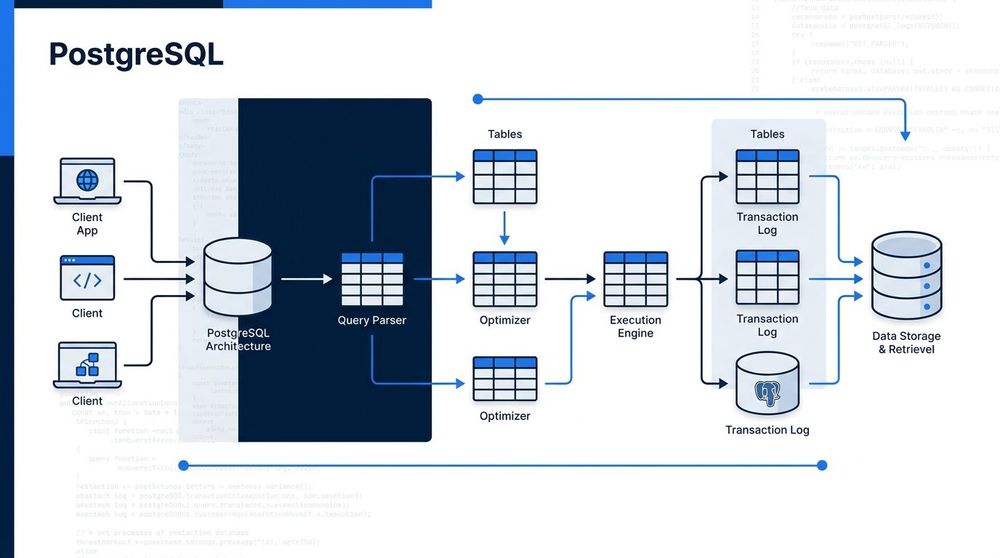
When a query is submitted, PostgreSQL routes it through a multi-stage pipeline: the parser checks syntax and produces a parse tree, the rewriter applies any relevant rules or view definitions, the planner generates a cost-estimated execution plan, and the executor carries that plan out against the actual data. The planner is particularly sophisticated—it evaluates multiple join strategies, index options, and row-count statistics gathered by the ANALYZE command to choose the lowest-cost path. This statistics-driven approach means query performance generally improves as the planner accumulates more accurate data about a table's contents.
PostgreSQL guarantees ACID compliance (Atomicity, Consistency, Isolation, Durability) across all transactions, ensuring that data remains consistent even in the event of a crash or concurrent write contention. Concurrency is managed through Multi-Version Concurrency Control (MVCC), which keeps multiple versions of a row in storage so that readers never block writers and writers never block readers. Each transaction sees a snapshot of the database as it existed at the start of that transaction, eliminating dirty reads without resorting to coarse-grained table locks. Beyond standard data types, PostgreSQL supports a rich extensible type system—users can define custom types, operators, and index methods—making it adaptable to workloads far beyond conventional relational data.
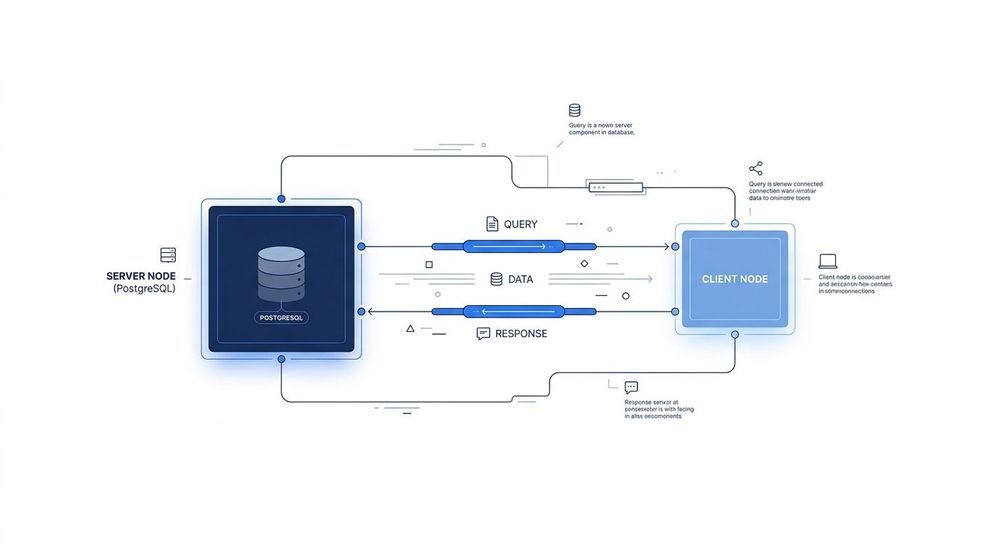
PostgreSQL operates on a process-per-connection model. Each client session is handled by a dedicated backend process, which parses the incoming SQL, passes it through the query planner and optimizer, and executes it against the storage engine. Changes are written to the write-ahead log (WAL) before they are applied to data files, ensuring durability even in the event of a crash. This separation of concerns—between connection handling, planning, execution, and persistence—makes PostgreSQL's internals predictable and well-suited to inspection and tuning.
One of PostgreSQL's most cited strengths is its strict conformance to the SQL standard, which reduces vendor lock-in and makes it easier to port schemas and queries between environments. Beyond standards compliance, the database is highly extensible: developers can define custom data types, operators, index methods, and procedural languages. This extensibility underpins a rich ecosystem of extensions—most notably PostGIS for geospatial data—that allow PostgreSQL to serve workloads far outside the scope of a typical relational database.
PostgreSQL provides full ACID (Atomicity, Consistency, Isolation, Durability) guarantees across all transactions, making it well-suited for applications where data integrity is non-negotiable, such as financial systems or healthcare records. Its support for JSONB—a binary JSON storage format with indexing support—lets it handle semi-structured data alongside relational data in the same database, reducing the need to introduce a separate document store for mixed workloads.
On the disadvantage side, PostgreSQL's memory consumption is higher than lighter-weight databases such as SQLite or MySQL in minimal configurations. It spawns a new process for each client connection, which can place significant memory pressure on servers handling large numbers of simultaneous connections; connection poolers like PgBouncer are commonly deployed to mitigate this. The operational overhead is real, and teams should account for it when planning infrastructure.
Replication in PostgreSQL has historically been more complex to configure than in some competing systems. While streaming replication and logical replication are both supported natively, achieving high availability with automatic failover typically requires additional tooling such as Patroni or repmgr. For teams new to the database, the breadth of configuration options and the depth of its feature set can also present a steeper initial learning curve compared to simpler databases—though most developers find that investment pays off as workload complexity grows.
A comparison of PostgreSQL, MySQL, and SQLite across key technical dimensions. Choices depend on application complexity, concurrency requirements, and deployment environment.
PostgreSQL is a natural fit for web application backends that require relational integrity alongside flexible JSON storage. Its PostGIS extension makes it the standard choice for geospatial applications, enabling precise geographic queries on location data. Financial systems benefit from PostgreSQL's strict ACID compliance, which guarantees that transactions either complete fully or not at all. For analytics workloads, features like window functions and CTEs allow complex reporting queries to run directly against the database without a separate analytics layer.
PostgreSQL has maintained a reputation for reliability and standards compliance over more than three decades of active development. Its architecture supports a wide range of workloads — from small single-server applications to large distributed systems handling millions of transactions — without requiring a change in database technology as a project scales. Features such as ACID-compliant transactions, robust indexing options, and native support for JSON alongside relational data make it a genuinely flexible choice rather than one optimized for a narrow category of use cases.
What distinguishes PostgreSQL from many of its peers is the combination of technical depth and an active open-source community that continues to extend its capabilities with each major release. It is not a database that trades correctness for convenience or performance for simplicity; instead, it attempts to provide all of these properties together, with well-documented tradeoffs when they cannot be fully reconciled. For teams evaluating a general-purpose relational database, PostgreSQL's track record, extensibility, and broad ecosystem of tooling make it a well-supported long-term foundation.
