Technologies
spaCy

spaCy is an open-source natural language processing (NLP) library for Python, designed for practical, production-ready use rather than research experimentation. Developed by Explosion AI and first released in 2015, it provides tools for tasks such as tokenization, part-of-speech tagging, named entity recognition, dependency parsing, and text classification. Unlike many NLP libraries that prioritize flexibility for academic exploration, spaCy is built with speed and developer experience as primary design goals, making it a common choice for teams integrating language understanding into real-world software systems.
The library follows an opinionated design philosophy: rather than exposing many competing approaches to the same problem, spaCy offers a single, well-optimized pipeline for each task. This means developers get sensible defaults and efficient processing out of the box, at the cost of some configurability. spaCy supports a wide range of languages and provides pre-trained statistical models that can be downloaded and used immediately, covering everything from lightweight models suited to resource-constrained environments to larger, transformer-based models for higher accuracy.
spaCy was created by Matthew Honnibal and Ines Montani and first released in 2015 by the company they founded, Explosion AI (later rebranded simply as Explosion). Unlike many academic NLP tools of its era, spaCy was designed from the outset with production use in mind — prioritizing speed, memory efficiency, and a clean API over research flexibility or exhaustive configurability. This practical orientation distinguished it early on from contemporaries such as NLTK and Stanford CoreNLP, which were built primarily to serve computational linguistics research.
Over subsequent major releases, spaCy expanded from a focused English tokenizer and dependency parser into a full-featured, multilingual NLP framework. The v3.0 release in 2021 represented a significant architectural overhaul, introducing a configuration-driven training system and native integration with transformer-based models via the companion library spacy-transformers. By this point spaCy had accumulated widespread adoption across industry, data science, and research teams, cementing its position as one of the most actively maintained NLP libraries in the Python ecosystem.
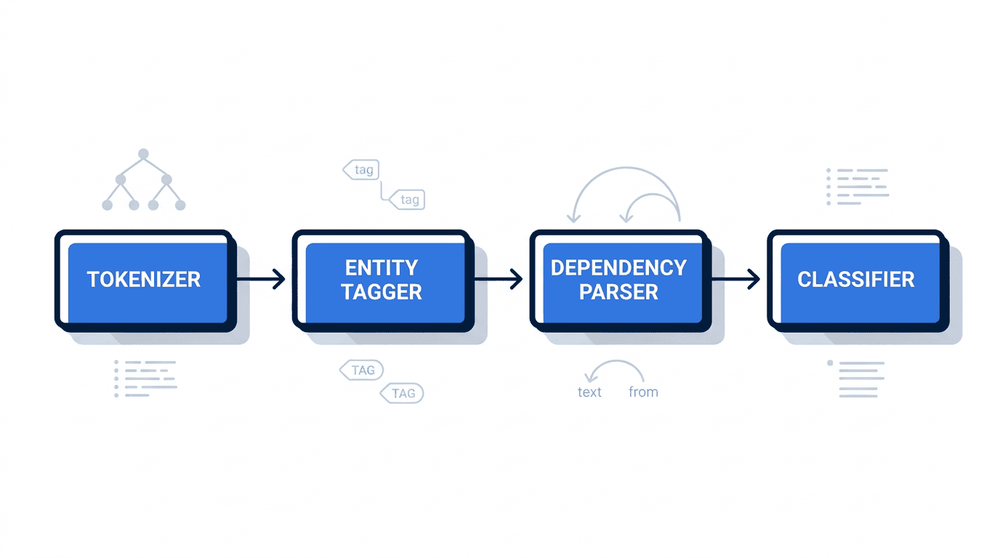
When text is passed to a spaCy nlp object, it moves through a series of pipeline components in sequence, each adding annotations to the resulting Doc object. The first step is tokenization, where the raw string is split into individual Token objects based on language-specific rules for whitespace, punctuation, and special cases such as contractions or URLs. Subsequent components—including the tagger, parser, and named entity recognizer (NER)—operate on this token sequence, enriching each token with attributes like part-of-speech labels, syntactic dependency relations, and entity type classifications.
The dependency parser assigns each token a grammatical role relative to a head token, producing a tree structure that captures subject-verb-object relationships and other syntactic patterns across the sentence. The NER component identifies spans of tokens that refer to named entities—such as people, organizations, locations, or dates—and labels them with a corresponding type. Because each component writes its output back into the shared Doc object, downstream components can build on earlier annotations, and the pipeline as a whole can be customized by adding, removing, or replacing individual components to suit a specific task.
When raw text is passed to a spaCy model, it travels through a series of pipeline components in a fixed sequence. The tokenizer runs first, splitting the text into individual Token objects and assembling them into a Doc. Subsequent components—such as the tagger, parser, named entity recognizer, and lemmatizer—each annotate that same Doc in turn, adding linguistic attributes without duplicating the underlying data. The result is a single Doc object carrying the full set of annotations produced by every component in the pipeline.
One of spaCy's most cited strengths is its performance. The library is built for speed, using Cython under the hood to execute computationally intensive operations close to native C speeds. This makes it well-suited for processing large volumes of text in production environments where throughput matters. Unlike some NLP frameworks that prioritize research flexibility over runtime efficiency, spaCy is explicitly designed around production use cases.
spaCy ships with pre-trained statistical models for a range of languages, covering tasks such as part-of-speech tagging, named entity recognition, and dependency parsing out of the box. These models are trained on real-world corpora and provide strong baseline accuracy without requiring teams to build pipelines from scratch. The availability of transformer-based models, integrated via the spacy-transformers package, further closes the gap between production-ready tooling and state-of-the-art accuracy.
The library does carry some limitations worth considering. spaCy's customization model is opinionated — components are expected to conform to its pipeline architecture, and deviating from that structure requires deeper familiarity with its internals. Teams that need to experiment freely with novel model architectures or unusual training setups may find frameworks like Hugging Face Transformers or AllenNLP more accommodating. spaCy's focus on robust, deployable pipelines means it trades some research flexibility for engineering reliability.
Language coverage is another practical constraint. While spaCy supports a growing number of languages, the depth of available models varies significantly — some languages have full statistical pipelines with vectors, while others offer only basic tokenization rules. Projects targeting low-resource languages may need to supplement spaCy's built-in models with custom training data or external tools. Additionally, very small teams or individuals new to NLP may face a steeper initial learning curve compared to simpler, higher-level libraries, particularly when configuring training runs via the newer config-based system introduced in spaCy v3.
Comparison of spaCy against common NLP libraries across speed, ease of use, and suitability for production environments.
spaCy is widely used in information extraction pipelines, where it identifies named entities such as organisations, locations, and dates from unstructured text at scale. Chatbot and conversational AI systems rely on spaCy for intent recognition and entity detection. Document processing workflows—such as contract analysis or news aggregation—use spaCy to classify text and extract structured data. Its speed and production-ready design make it a practical choice wherever large volumes of text must be processed consistently and efficiently.
spaCy occupies a well-defined position in the NLP landscape: it is a production-oriented library designed for teams that need to process real text at scale, extract structured information, and integrate linguistic analysis into larger software pipelines. Its opinionated design—offering one well-tuned model per task rather than a menu of research alternatives—makes it faster to adopt and easier to maintain than more experimental frameworks. Projects involving named entity recognition, dependency parsing, text classification, or custom information extraction are where spaCy consistently delivers practical value.
spaCy is the right tool when reliability, speed, and ecosystem maturity outweigh the need for cutting-edge research flexibility. For teams building document processing pipelines, annotation workflows, or multilingual NLP features in production applications, its combination of pretrained models, a composable pipeline architecture, and tight integration with transformer libraries through spaCy-transformers covers the vast majority of real-world requirements. Where a project demands rapid prototyping of novel model architectures or deep academic experimentation, other frameworks may be better suited—but for applied NLP work that needs to ship and scale, spaCy remains one of the most pragmatic choices available.