Technologies
Vue.js

Vue.js is an open-source progressive JavaScript framework designed for building user interfaces and single-page applications. Created by Evan You and first released in 2014, Vue is described as "progressive" because it can be adopted incrementally — developers can use it to enhance a small part of an existing page or scale it up to power a full client-side application. Unlike more opinionated frameworks, Vue makes no assumptions about the broader tooling stack, which allows it to integrate into a project with minimal friction.
At its core, Vue focuses on the view layer of an application — the part responsible for rendering data to the user and responding to user input. It borrows ideas from both React and AngularJS, combining a component-based architecture with a reactive data binding system. This positioning has made Vue a popular choice for teams that want a structured, maintainable frontend without the steep learning curve associated with more comprehensive frameworks.
Vue.js was created by Evan You, a former Google engineer who had worked extensively with AngularJS while building internal tools at the company. After leaving Google, You set out to distill what he found most useful in Angular — particularly its declarative data binding — into a lighter, more approachable package, without the framework's heavier architecture and steeper learning curve. The first public release appeared in 2014, initially as a personal project, and it gradually attracted community attention before growing into one of the most widely used JavaScript frameworks.
The central idea behind Vue's design is progressive adoptability — the framework is structured so that it can be introduced incrementally into an existing project rather than requiring an all-or-nothing adoption. A developer can start by dropping Vue into a single page to manage one interactive component, then gradually expand its use across a larger application as needed. This contrasts with more opinionated frameworks that demand a particular project structure from the outset. The philosophy made Vue particularly appealing to teams migrating existing codebases or working in environments where a full framework rewrite was not practical.
At the core of Vue.js is a reactive data system that tracks dependencies between component state and the DOM. When a piece of data changes, Vue automatically determines which parts of the rendered output are affected and updates only those elements. This is made possible through Vue's virtual DOM, a lightweight in-memory representation of the actual DOM that Vue diffs against the previous state before committing minimal changes to the browser. The result is efficient rendering without requiring developers to manually manage DOM updates.
Vue offers two distinct styles for writing component logic. The Options API organizes a component's code into named option objects—data, methods, computed, and watch—which is approachable for developers new to the framework. The Composition API, introduced in Vue 3, provides a function-based approach using composables such as ref and reactive, allowing related logic to be grouped by feature rather than by option type. Both APIs are fully supported and can be mixed within the same project, giving teams the flexibility to adopt whichever style fits their codebase.
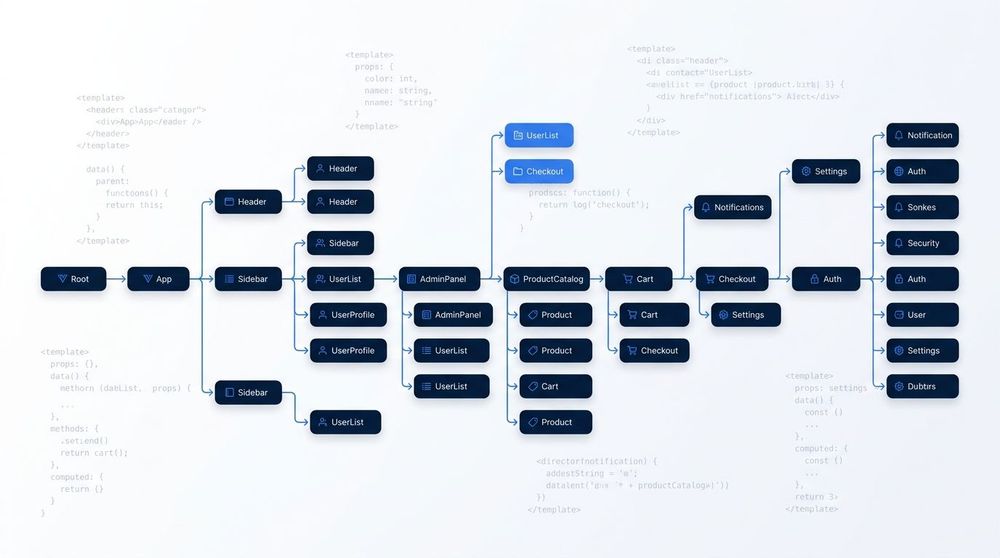
Vue.js applications are built from a tree of components, each encapsulating its own template, logic, and styles. Data flows downward from parent to child through props—typed values a parent passes explicitly to its children. Communication in the other direction travels back up via custom events, which a child emits and a parent listens for. This unidirectional flow keeps data predictable: a component's state cannot be modified from below, only from the component that owns it.
One of Vue.js's most recognized strengths is its gentle learning curve. Developers familiar with HTML, CSS, and basic JavaScript can build functional components relatively quickly, without needing to learn a fundamentally new mental model. The framework's single-file component structure keeps template, logic, and styles co-located in a way that feels intuitive, which reduces onboarding time compared to some alternatives that require more upfront configuration or paradigm shifts.
Vue also offers considerable flexibility in how it is adopted. It can be incrementally introduced into an existing project — applied to a single widget or page section — or used as the foundation for a full single-page application. Its reactivity system and component model integrate well with other libraries, and the official ecosystem (Vue Router for client-side routing, Pinia for state management) provides a coherent set of tools without locking teams into a rigid structure. The Composition API, introduced in Vue 3, adds further flexibility by allowing logic to be organized by concern rather than by component option type, which benefits larger and more complex codebases.
On the other side, Vue's corporate backing is less centralized than that of frameworks maintained by large technology companies. The project is led primarily by its creator and a core team, supported by community sponsorship rather than a single corporate sponsor with deep resources. This has not historically prevented Vue from being well-maintained, but it does mean the long-term roadmap is more dependent on community support and individual contributors than frameworks backed by organizations with dedicated engineering headcount.
A further consideration is inconsistency across the broader community ecosystem. Because Vue's third-party package landscape is large and decentralized, the quality and maintenance status of community libraries varies considerably. Teams relying on less-maintained packages may encounter compatibility gaps — particularly when migrating between Vue 2 and Vue 3, which involved breaking changes significant enough that many ecosystem libraries required substantial rewrites before they were ready for the newer version. Projects planning a major version migration should audit their dependencies carefully before committing to a timeline.
Comparison of Vue.js, React, and Angular across key dimensions. Each framework suits different team sizes, project scopes, and architectural preferences.
Vue.js is most commonly chosen for single-page applications (SPAs) where the entire user interface is rendered and managed in the browser without full page reloads. Its reactive data binding and component system make it well suited for building dashboards, admin panels, and interactive forms where the UI must respond immediately to user input. Vue's official router and state management libraries integrate cleanly with the core framework, giving teams a complete foundation for SPA development without requiring them to assemble unrelated third-party tools.
Beyond greenfield SPAs, Vue is frequently used for progressive enhancement of existing server-rendered pages — dropping Vue into a specific part of a page rather than rebuilding the whole application. This incremental adoption path makes it a practical choice for teams that maintain legacy codebases and want to modernize individual components over time. Vue is also a common pick for rapid prototyping, where its low setup overhead and readable template syntax allow developers to produce working interfaces quickly before committing to a full production architecture.

A typical Vue.js project draws on three companion libraries that cover the most common application needs. Vue Router handles client-side navigation, mapping URL paths to components and supporting nested routes. Pinia — the current recommended state management library, succeeding Vuex — provides a lightweight store for sharing data across components. Vite serves as the default build tool, offering fast hot module replacement during development and optimized production bundles. Together, these three tools form a predictable, well-documented foundation that covers routing, state, and build concerns without requiring additional configuration overhead.
Vue.js has established itself as a mature, well-regarded framework in the modern frontend landscape by staying true to its founding principle: progressiveness. Teams can adopt it incrementally, starting with a simple script include and expanding toward a full single-page application architecture as requirements grow. Its approachable template syntax, clear reactivity model, and thorough documentation make it a practical choice for both small projects and large-scale applications alike.
Like any technology, Vue.js comes with real tradeoffs. Its smaller corporate backing and ecosystem footprint compared to React mean that certain enterprise tooling and third-party integrations may be less mature. At the same time, the framework's focused scope, strong community, and consistent design philosophy have allowed it to remain a competitive and actively maintained option for frontend development teams evaluating their stack.