Technologies
NGINX

NGINX (pronounced "engine-x") is an open-source software originally released in 2004 by Russian developer Igor Sysoev. It was designed to address the C10k problem—the challenge of handling ten thousand concurrent connections efficiently—at a time when the dominant web server, Apache, struggled under high concurrency loads. Today, NGINX functions as a web server, reverse proxy, load balancer, and HTTP cache, making it one of the most versatile infrastructure components in modern web architectures.
Unlike traditional process-per-connection models, NGINX uses an event-driven, asynchronous architecture that allows a single worker process to handle thousands of simultaneous connections with low memory overhead. This design makes it particularly well-suited to serving static content at high speed, proxying requests to application servers, and acting as the public-facing entry point for distributed backend systems. It is widely deployed across both high-traffic websites and smaller production environments where performance and reliability are priorities.
NGINX was created by Igor Sysoev, a Russian software engineer, and first released publicly in 2004. Its design was motivated by the C10k problem — a well-documented challenge in web server architecture describing the difficulty of handling ten thousand concurrent client connections on a single server. Traditional web servers of the era, such as Apache HTTP Server, relied on a process-per-connection or thread-per-connection model that consumed significant memory and CPU resources as connection counts scaled, making the C10k threshold a practical ceiling for many deployments.
To address this, Sysoev designed NGINX around an event-driven, asynchronous architecture that handles many connections within a small number of worker processes, rather than spawning a new thread or process for each request. This approach proved highly efficient under load and attracted rapid adoption. Over the years, NGINX expanded beyond its origins as a web server to become a widely used reverse proxy, load balancer, and HTTP cache. In 2011, Sysoev co-founded NGINX, Inc. to support commercial development; the company was acquired by F5 Networks in 2019, though the open-source project has continued under active maintenance.

Traditional web servers spawn a new thread or process for each incoming request, which consumes memory and CPU proportionally to traffic. NGINX takes a fundamentally different approach: a small number of worker processes each run a non-blocking event loop, handling thousands of concurrent connections within a single thread. When a connection is waiting on disk I/O or a slow upstream, the worker simply moves on to the next event rather than blocking. This model keeps resource usage low and predictable even under high concurrency.
NGINX's most frequently cited advantage is its ability to handle a very large number of simultaneous connections without a corresponding increase in memory consumption. Because each worker process handles requests through a non-blocking, event-driven loop rather than spawning a separate thread per connection, the memory footprint remains relatively flat even under heavy load. This makes NGINX well suited to high-traffic environments where a thread-per-connection model would exhaust system resources quickly.
Beyond raw concurrency, NGINX is also valued for its versatility. The same installation can function as an HTTP web server, a reverse proxy, a load balancer, and an HTTP cache, reducing the number of distinct components a team needs to operate and maintain. Its static file serving performance is particularly strong, and its configuration syntax—once learned—is concise and expressive, which simplifies building complex routing or upstream rules in a relatively small number of lines.
The disadvantages are real and worth understanding before adopting NGINX. Configuration can be non-trivial: the distinction between the server and location block hierarchy, the behavior of directive inheritance, and the correct use of try_files or rewrite rules are common sources of subtle errors. Mistakes in configuration do not always produce obvious error messages, so debugging can require careful reading of documentation and logs.
NGINX also has limited native support for dynamic content. Unlike Apache's mod_php, which can execute PHP in-process, NGINX must delegate dynamic requests to an external process—typically via FastCGI or a separate application server. This is not inherently a problem in modern architectures, where application logic typically runs in its own process anyway, but it does mean NGINX cannot serve dynamic content entirely on its own and requires additional infrastructure to do so.
Key architectural and operational differences between NGINX and Apache across concurrency, performance, configuration, and dynamic content support.
NGINX sees its widest use as a static file server and reverse proxy. When serving static assets—HTML, CSS, JavaScript, and images—NGINX reads files directly from disk and streams them to the client without involving an application process, making it significantly more efficient than passing those requests through a dynamic language runtime. As a reverse proxy, it sits in front of application servers such as Node.js, Django, or Rails instances, forwarding incoming HTTP requests and returning responses to the client, while shielding the backend from direct exposure to the internet.
Beyond static serving and proxying, NGINX is commonly deployed for load balancing, distributing traffic across multiple backend instances using strategies such as round-robin or least-connections. It also handles TLS termination: accepting encrypted HTTPS connections from clients, decrypting them, and forwarding plain HTTP to backend services, which simplifies certificate management and offloads cryptographic work from application servers. In microservices architectures, NGINX increasingly functions as an API gateway, routing requests to different upstream services based on URL paths, applying rate limiting, and enforcing authentication at the edge before traffic reaches individual services.
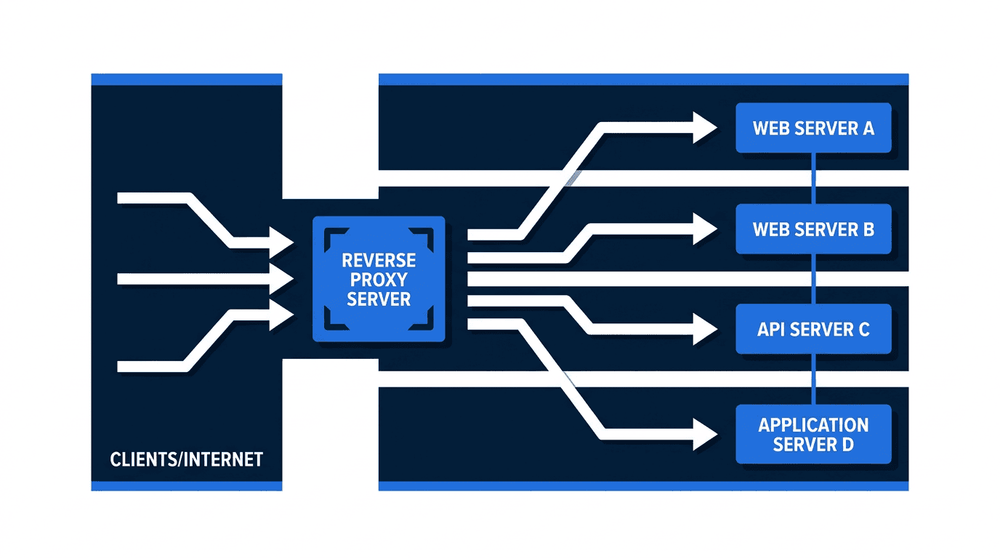
In a typical deployment, NGINX sits at the network edge, accepting incoming HTTP and HTTPS requests from the internet before forwarding them to one or more upstream application server instances. This reverse proxy layer decouples the public-facing entry point from the backend processes, allowing requests to be distributed across multiple instances for load balancing, while SSL termination and caching are handled centrally. Application servers never need to be exposed directly to external traffic.
NGINX has established itself as a foundational component in modern web infrastructure, valued for its ability to handle high concurrency with minimal memory overhead. Whether deployed as a standalone web server, a reverse proxy in front of application servers, a load balancer distributing traffic across backend nodes, or a caching layer reducing upstream load, it fulfills multiple roles within a single, consistently configured tool. This versatility makes it a common presence across deployments that range from single-server setups to large-scale distributed systems.
Its event-driven, non-blocking architecture distinguishes it from older process-per-connection models, allowing it to serve large numbers of simultaneous requests without a proportional increase in resource consumption. As containerized environments and microservices architectures have become prevalent, NGINX has adapted accordingly — appearing as an ingress controller in Kubernetes clusters, a sidecar proxy in service meshes, and a static asset server in CI/CD pipelines. Understanding NGINX's core design and configuration model gives engineers a reliable, well-documented tool for solving a wide range of network and application delivery challenges.