Technologies
Redis

Redis (Remote Dictionary Server) is an open-source, in-memory data structure store that can function as a database, cache, and message broker. Originally released in 2009 by Salvatore Sanfilippo, it stores data primarily in RAM rather than on disk, which allows it to deliver extremely low read and write latencies. Redis supports a rich set of data structures—including strings, hashes, lists, sets, sorted sets, bitmaps, and streams—making it more versatile than a simple key-value store.
Unlike traditional relational databases that persist data to disk by default, Redis keeps its working dataset in memory and offers optional persistence mechanisms, such as snapshotting and append-only file logging, to survive restarts. It is single-threaded for command execution, which simplifies concurrency handling and ensures atomic operations without the need for locks. Redis is widely used across industries as a building block for caching layers, real-time leaderboards, session stores, and pub/sub messaging systems.
Redis was created by Salvatore Sanfilippo in 2009 while he was working on a real-time web analytics tool and found that traditional disk-based databases could not keep up with the performance demands of his application. His solution was to design a data store that kept its entire dataset in memory, trading persistence guarantees for dramatically lower latency. Sanfilippo released Redis as an open-source project, and it quickly attracted attention from developers facing similar scalability problems in web applications, messaging systems, and caching layers.
Over the following years, Redis grew from a personal side project into one of the most widely deployed in-memory data stores in the industry. VMware and later Pivotal sponsored Sanfilippo's work, and in 2015 Redis Labs (now Redis Inc.) was formed to provide commercial support and managed cloud offerings around the open-source core. The project has consistently ranked among the most popular databases in developer surveys, reflecting its broad adoption across use cases that range from session caching to real-time leaderboards and pub/sub messaging.
Redis organizes all stored data under named keys, each associated with one of its core data types: strings, hashes, lists, sets, sorted sets, and — in newer releases — types such as streams, bitmaps, and HyperLogLogs. A string is the simplest type and can hold text, integers, or binary data up to 512 MB. Hashes map field-value pairs under a single key, making them well suited to representing objects. Lists are ordered sequences of strings that support push and pop operations from either end, while sets store unordered collections of unique elements. Sorted sets extend this by assigning each member a floating-point score, enabling efficient range queries ordered by that score.
Because Redis keeps its entire dataset in RAM, reads and writes are extremely fast, but durability requires additional configuration. Redis offers two persistence mechanisms: RDB snapshots, which write a point-in-time copy of the dataset to disk at configurable intervals, and AOF (Append-Only File), which logs every write operation so the dataset can be reconstructed on restart. Both mechanisms can be used together for stronger durability guarantees. For horizontal scalability and fault tolerance, Redis supports replication — where one primary node streams writes to one or more read replicas — and Redis Cluster, which automatically partitions data across multiple nodes using hash slots, allowing the dataset and throughput to scale beyond what a single machine can handle.

In a typical deployment, Redis sits between the application layer and a persistent database such as PostgreSQL or MySQL. Read requests that would otherwise hit the database are served directly from Redis in memory, reducing latency from milliseconds to microseconds. The same Redis instance can simultaneously act as a message broker, passing events between services through its Pub/Sub or Streams interfaces. This dual role—cache and broker—means teams can introduce Redis at a single point in their infrastructure and gain both capabilities without additional components.
The defining advantage of Redis is its speed. Because all data is stored in memory rather than on disk, read and write operations typically complete in under a millisecond, even under high concurrency. This makes Redis well-suited for workloads that require consistent low latency at scale, such as session management, real-time leaderboards, or rate limiting. The in-memory architecture eliminates the seek times associated with traditional disk-based storage, and Redis's single-threaded command execution model ensures that operations are processed without lock contention.
Beyond raw speed, Redis offers a rich set of native data structures — strings, hashes, lists, sets, sorted sets, bitmaps, hyperloglogs, and streams — each with its own set of purpose-built commands. This versatility means that many common data manipulation tasks can be handled directly by Redis without requiring application-side logic. Atomic operations are supported across most data types, and Redis also includes a Lua scripting interface that allows multiple commands to be executed as a single atomic unit. Its pub/sub messaging capability enables lightweight event broadcasting between services without requiring a dedicated message broker.
The primary constraint of Redis is memory capacity. Storing all data in RAM means that the total dataset size is bounded by available memory, which is significantly more expensive per gigabyte than disk storage. Large datasets either require careful eviction policies — Redis supports several, including LRU and LFU variants — or a clustered deployment to distribute data across multiple nodes. Neither approach eliminates the cost difference; they simply manage it.
Redis also has limited query capabilities compared to relational or document databases. There is no support for ad hoc queries with filtering across multiple fields, joins, or aggregations in the way a SQL database provides. Data access patterns must be designed upfront, with keys and data structures chosen to match the specific access needs of the application. This makes Redis less suitable as a general-purpose database and more appropriate as a specialized store layered alongside a primary database. Persistence options such as RDB snapshots and AOF logging reduce the risk of data loss, but Redis is still commonly treated as a cache or secondary store rather than a system of record.
Comparison of Redis against common in-memory and caching alternatives across data structure support, persistence options, and clustering capabilities.
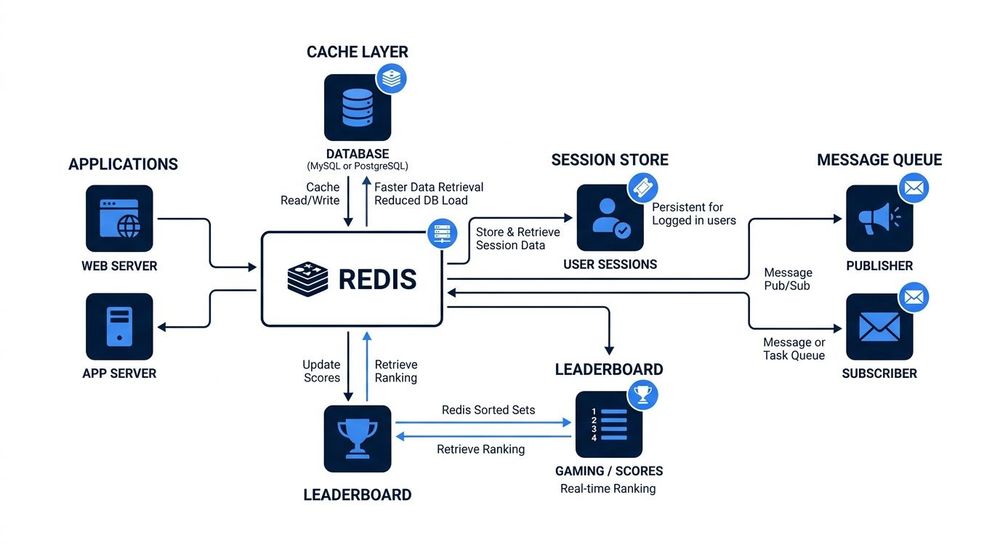
Redis appears most often in roles where speed and simplicity are essential. Session storage is one of the earliest adopters: user session data lives in Redis rather than a relational database, reducing read latency significantly. Leaderboards take advantage of sorted sets to rank players or scores in real time without expensive SQL queries. Rate limiting uses atomic increment operations to count requests per time window. Pub/sub messaging enables lightweight event broadcasting between services, while real-time analytics pipelines use Redis to buffer and aggregate high-frequency event streams.
Redis occupies a well-defined niche in modern application architecture: it excels as an in-memory data store where low latency and high throughput are more critical than durable, relational storage. Its support for rich data structures—strings, hashes, lists, sorted sets, streams, and more—means it can serve as a cache, a message broker, a session store, a leaderboard engine, or a real-time analytics layer, often within the same deployment. Teams typically reach for Redis when a relational database or document store introduces unacceptable latency under read-heavy workloads, or when they need a lightweight pub/sub or queue mechanism without committing to a heavier messaging system.
The tradeoffs worth keeping in mind are straightforward: Redis's entire working dataset must fit in RAM, which makes it more expensive to scale than disk-based stores, and its durability guarantees—even with AOF persistence enabled—are weaker than those of a purpose-built relational database. For workloads where occasional data loss is acceptable, or where Redis sits in front of a durable primary store, these constraints rarely matter. Where they do matter, careful configuration of persistence and replication is necessary before Redis can be trusted as a system of record. Understanding these boundaries is what distinguishes teams that use Redis effectively from those that encounter subtle data loss or memory pressure in production.